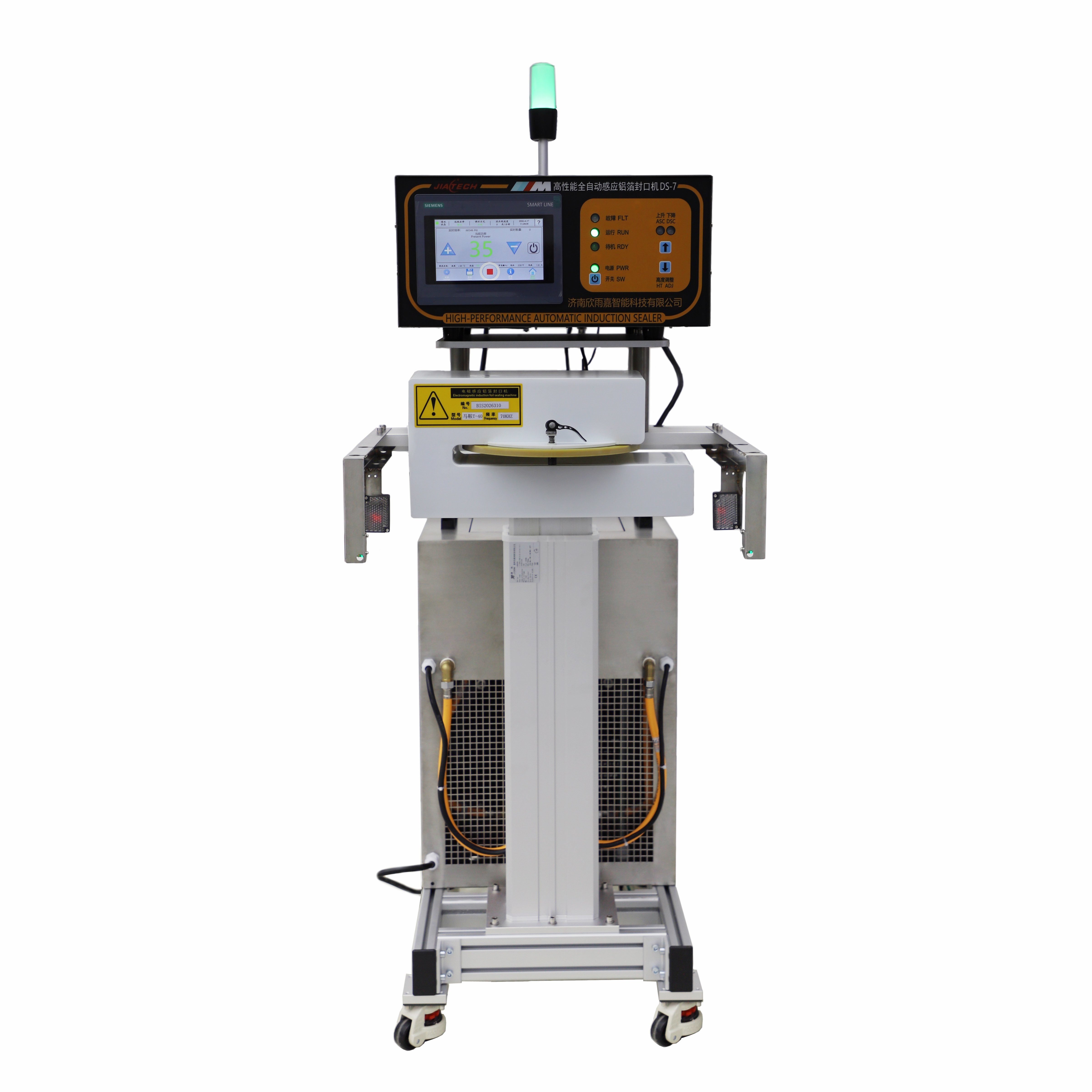
Digital · integrated
DS-7 — one-piece digital sealer
- Power 4.5 kW
- Caps 15–140 mm
- Speed 1–40 m/min
- Head lift auto, 710–1315 mm


Building induction sealers in Jinan since 2000
We do one thing: induction cap sealing for PET, PE and glass bottles. Digital control that re-locks its own frequency, a rotary head that seals off-centre caps, and a 304 stainless build your QA team can walk into a GMP audit with.
Where the machine has to behave
Six industries, six different failure modes. Pick yours — the second column is what we change on the machine before it ships.
Your buyer opens the bottle and hears the membrane peel. That is the tamper evidence. If the seal is weak, the batch is suspect — so the machine has to prove its own temperature, water pressure and inverter status on screen, every shift.
Solvent-based products attack cheap plastics, and the filling hall is never clean. We answer with a fully sealed cabinet, corrosion-resistant head construction and a cooling loop that keeps dust away from the electronics instead of blowing it through them.
Ketchup, chilli sauce, salad dressing: the lip is never perfectly clean, and the foil still has to weld to it. Higher power per millimetre and a head profile matched to your neck finish do the work that a generic sealer cannot.
Blending plants run continuously, and a sealer that derates after four hours is a bottleneck. Water-cooled heads, a 95% efficient power stage and an intelligent tank that only pumps when the machine is running keep the duty cycle honest.

A 20 mm cap on a tapered neck is where cheap sealers fail: the head cannot sit flat, so one side welds and the other lifts. Our rotary head tilts 0–90°, and frequency is re-scanned for every head you fit.
If your area is classified, the sealer is the ignition risk nobody budgets for. Our Ex version puts power, pump and controls in a certified explosion-proof cabinet, with Ex-rated flexible hoses and a sealed water loop.
Analog, digital or air-cooled
Buyers usually arrive asking for "an induction sealer" and leave needing a specific control type. Here is the honest difference.
| What matters | Analog high-powerBIS-4000 series | Digital water-cooledDS seriesMost specified | Air-cooled digitalAir · WD-1 |
|---|---|---|---|
| Best for | Heavy 4 kW sealing on high-throughput lines, budget-driven projects | Lines that cannot stop — multi-shift, many cap sizes, GMP audits | Small batches, sample rooms, low-speed or intermittent filling |
| Line speed | 10–250 bottles/min (tunnel head) | Up to 70 m/min · 10–200 mm caps | 10–180 bottles/min · 1–20 m/min |
| Control | Transistor module, analogue setting, 42 A CMOS stage | FPGA + MCU dual core, every working point set in software | Digital, knob or touchscreen, auto frequency search |
| Cooling | Dual fan, internal water loop, dual heatsink | Sealed intelligent water tank, high-flow pump, Ex-rated hoses on DS-F | Fan only — no water, no plumbing |
| Drift over time | Settings shift as RC components age and heat | Self-checks on start-up; parameters do not walk | Low drift, but duty cycle limited by airflow |
| Build | Steel cabinet, splash-resistant | 304 stainless, sealed main circuit, GMP-ready | 304 stainless head, aluminium lift column |
| Budget | Lowest per kW | Mid to upper — pays back on scrap reduction | Lowest entry point |
| Typical buyer | Lubricant blenders, water plants, cost-first projects | Pharma, agrochemical, food brands, OEM line builders | Contract packers, cosmetic startups, R&D |
Not sure which column you are in? Send the bottle and the line speed — we answer with one recommendation, not a catalogue.
The range · model names live here, not in our marketing
All nine models share one control platform and one spare-parts pool. These six are the ones buyers actually order.
Digital · integrated
Digital · fastest
Digital · value
Air-cooled · touchscreen

Air-cooled · entry
Analog · 4 kW
Full specification
Engineers: this is the table you paste into your comparison sheet. Ranges marked "on request" are built to the bottle, so we quote them instead of guessing.
| Model | Control | Power | Frequency | Cap Ø | Line speed | Structure | Build | Notes |
|---|---|---|---|---|---|---|---|---|
| DS-7 | FPGA digital | 4.5 kW | 60–90 kHz | 15–140 mm | 1–40 m/min | Integrated | 304 SS | Auto head height 710–1315 mm |
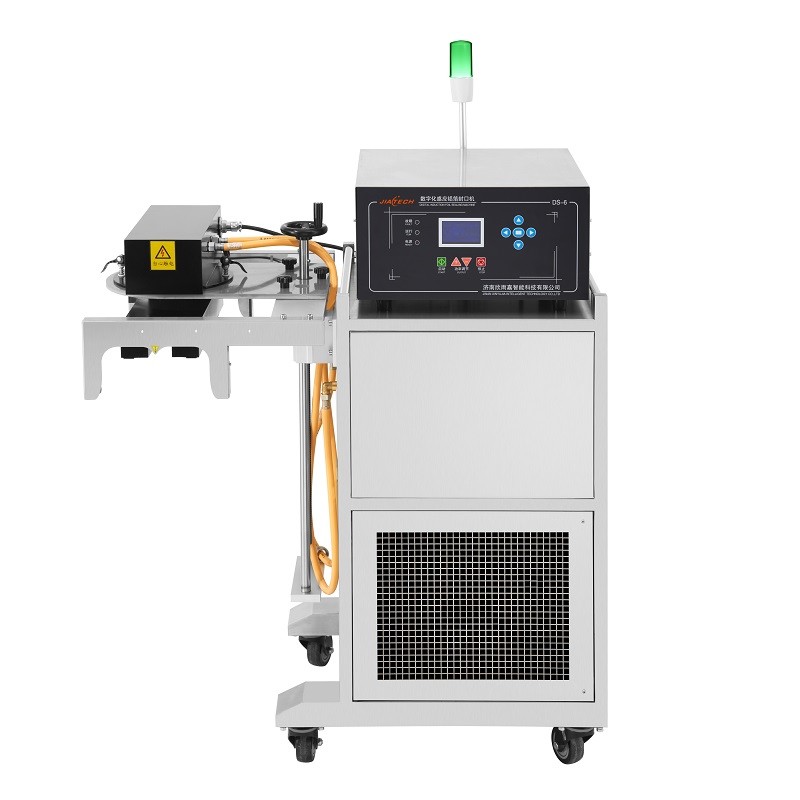
| DS-6 PLUS | FPGA digital | 5 kW | 60–90 kHz | 10–180 mm | 1–70 m/min | Split body | 304 SS | Fastest model in the range |
| DS-6 | FPGA digital | 5 kW adj. | 60–90 kHz | 10–200 mm | 1–60 m/min | Split body | 304 SS | Air or water cooled |
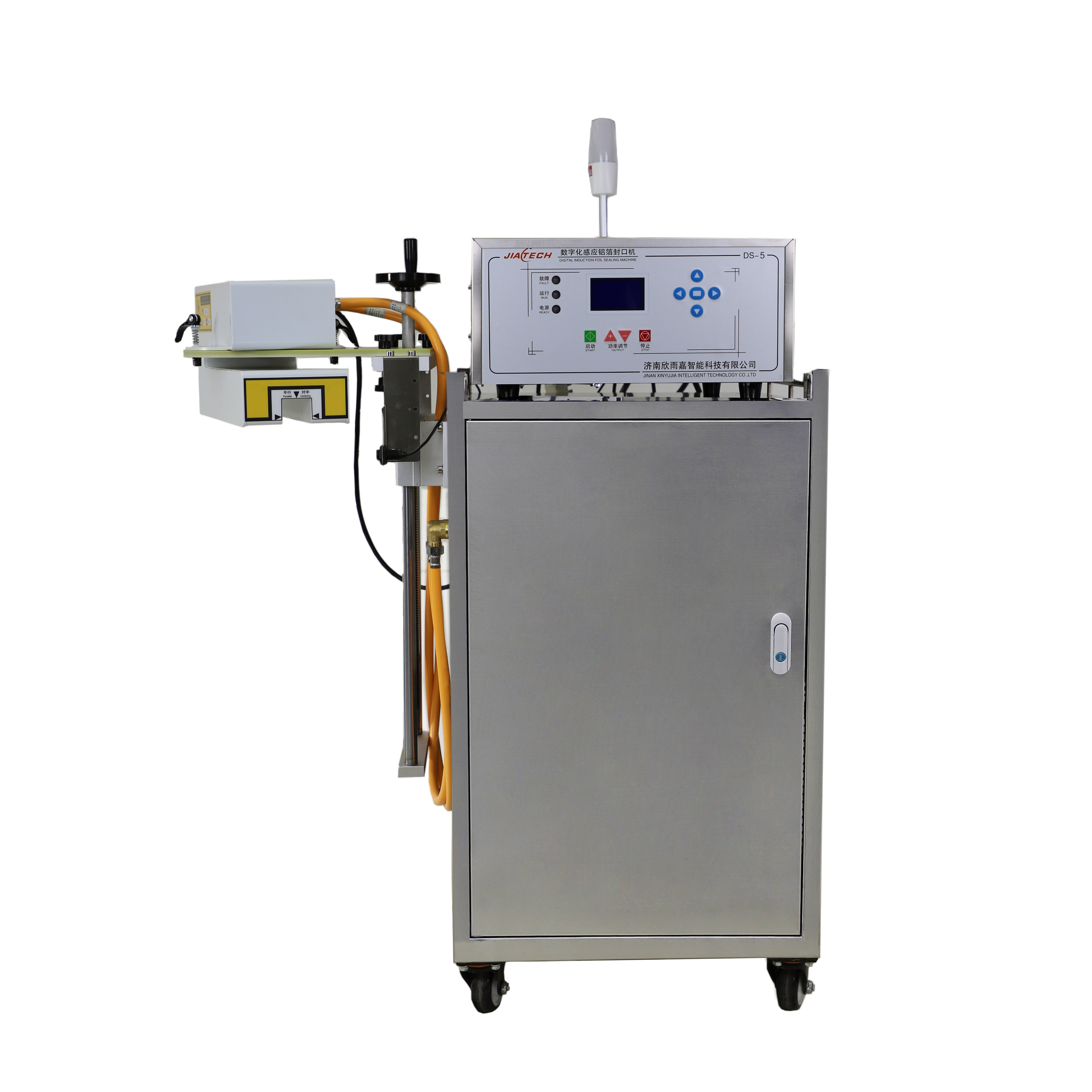
| DS-5 | DSP digital | 4.5 kW | 60–90 kHz | 15–140 mm | 1–40 m/min | Split body | 304 SS | Jam stop alarm standard |
| DS-F | FPGA digital | 4.5 kW | 60–90 kHz | 15–70 mm | 1–40 m/min | Integrated | 304 SS | Explosion-proof 380 V / 50 Hz |
| Air | Digital, touchscreen | 0–3 kW adj. | Auto search | 20–60 / 40–90 mm | 1–20 m/min | Split body | 304 SS head | Air-cooled, no water |
| WD-1 | Analog, dial | 2.3 kW adj. | 30–40 kHz | 20–60 / 60–110 mm | 1–15 m/min | Integrated | Steel / SS head | Small batch, intermittent use |
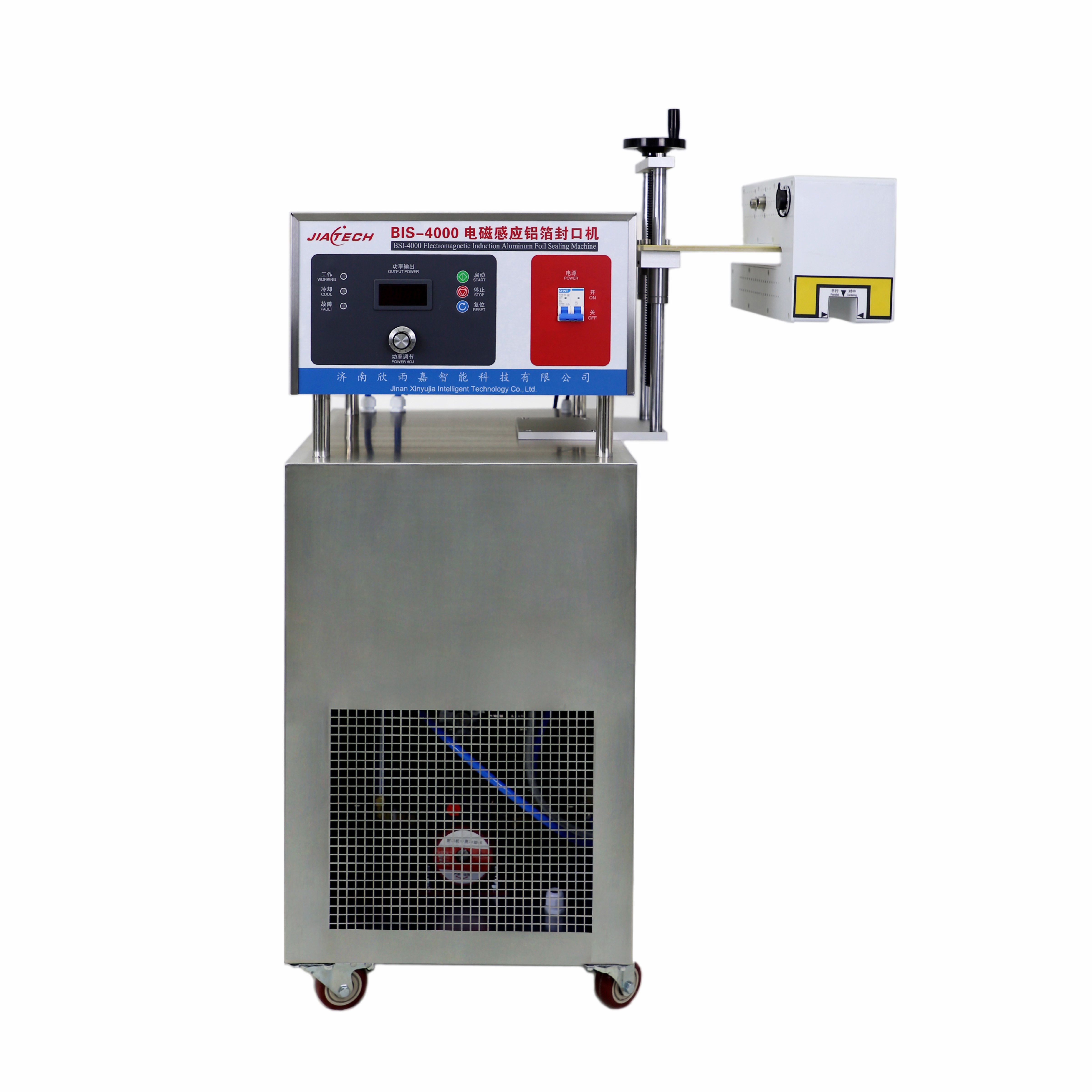
| BIS-4000 flat | Analog CMOS | 4 kW | Fixed stage | 20–65 mm | 10–200 bpm | Split body | Steel cabinet | Flat head, 220 V / 50 Hz |
| BIS-4000 tunnel | Analog CMOS | 4 kW | Fixed stage | 10–30 / 30–50 / 50–70 mm | 10–250 bpm | Split body | Steel cabinet | Tunnel head for hard cap sizes |
All models: 220 V / 50 Hz unless noted, 304 stainless housing on digital series, jam alarm and head over-temperature shutdown standard. Cap ranges outside the table are built to the bottle — send the drawing.
Why buyers switch to us
No "quality first, customer forever". These are engineering decisions you can check on the shop floor or in the manual.
An FPGA and a microcontroller run our own sealing algorithm. Every working point — power curve, resonance, timing — is set in software, so it does not drift when the cabinet heats up or the board ages. That is the difference between a seal that repeats at 08:00 and at 23:00.
Change the induction head for a different cap size and the machine re-finds resonance itself. One sealer can cover a 10 mm dropper and a 200 mm wide-mouth jar without a technician on site.
Our patented head tilts and adjusts for height and parallelism, so tapered or off-centre necks get the same energy all the way round. This is the fix for the "one side sealed, one side lifted" complaint that comes with fixed heads.
Over-current, over-voltage, under-voltage, inverter self-check, resonance self-check, head over-temperature shutdown, water temperature and pressure monitoring — all displayed on screen with alarm limits you can set. A fault tells you where it is.
The main circuit sits in a fully sealed compartment: dust, moisture and product vapour stay out. The housing is 304 stainless, which is what makes the machine acceptable in a GMP or HACCP walk-through.
Infineon MOSFETs, Lattice FPGA, ST microcontroller, Omron relays, Panasonic capacitors, Samyoung electrolytics. High efficiency is not a green claim here — it means a cooler cabinet and a smaller electricity line item.
How an order actually runs
Most of the risk in buying a sealer sits in step two — matching the head to the cap. We do that before you pay, not after.
Five to ten filled bottles with caps and foil, or a short video of the line with your target speed. Courier details are in the reply.
Your bottle runs on our bench with two or three head options. You get the sealing video, peel result and the power setting that worked.
One price for the machine, the matched head, spares kit and crating. Drawings and the electrical drawing come with it.
We run the machine for two hours, record it, then pack in an export crate with foam blocking. Photos of the packed unit before it leaves.
Wiring diagram in English, video call while your electrician connects it, and spare heads or boards shipped from stock afterwards.
Where our machines run
Since 2000 the machines have left for four continents — mostly into lubricant blending, agrochemical filling and pharmaceutical packaging lines.
Technical questions we get weekly
The short answer is usually yes — but the honest answer depends on cap material, neck finish and line speed.
PE, PP, PET, PVC and glass containers all seal normally, as long as the cap is not metal. The foil is coated on one side to bond with the container material — PE foil for PE and PET bottles, glass-grade foil for glass jars. Tell us the material and we ship the matching foil specification with the machine.
No. Induction sealing heats the aluminium foil through a plastic cap; a metal cap blocks the field and also gets hot itself. If your closure is metal, the seal has to be a different technology — say so up front and we will tell you honestly instead of selling you a machine that cannot do it.
Heads are built to the cap, not the other way round. Standard machines cover 10–200 mm depending on model, and anything outside that is a custom head — usually two to three weeks added to the lead time. One machine can hold several heads, each matched to a different bottle.
Published speed is a belt speed, not a promise for your bottle. Bigger caps and thicker foil need more energy per unit, so a 100 mm jar seals slower than a 28 mm dropper. That is exactly why we test-seal your sample before quoting: the number we give you afterwards is measured, not extrapolated.
Standard models are 220 V / 50 Hz; the explosion-proof model is 380 V / 50 Hz. For other supplies we confirm the configuration with the factory before quoting — we will not promise a voltage we cannot build, and we will not ship a machine with a transformer bolted on and call it solved.
Water-cooled units need the tank topped up and the water changed on a schedule, plus a check on hose condition — the digital versions use reinforced rubber hoses instead of ageing PVC. Air-cooled units need the fan path kept clear. Heads are consumable in the long run; boards and pumps are stock items, not special orders.
Yes. The digital series has 485 communication for start-stop, power adjustment and fault readout from your line PLC, and can be interlocked with a filler or conveyor. Tell us the PLC and the signal list you need and we will confirm it before the order.
Send the bottle photo on WhatsApp. Most answers come back the same working day, with the sealing video attached — no form, no waiting for a quotation system.
The questions buyers ask on the second call
Not product questions — the ones about buying from a Chinese factory at all.
You should compare. A distributor carries stock, which is worth real money the week your line is down. What they cannot do is change the head, the power curve or the voltage to your bottle — that has to happen at the factory, and we are the factory.
Yes. Single units are a normal order for us, and there is no minimum quantity for a standard model. Custom heads also start at one. What we will not do is pretend a one-off is a container order — freight is quoted honestly, per unit.
It should not happen, because we test-seal your bottle before shipping and record it. If it does, we work the fault with you on video first — most cases are head height or foil grade, not the machine. Replacement boards or heads ship from stock.
The same sales engineer who quoted you, on the same WhatsApp number. Spare parts stay available because the platform has not changed since the digital series launched — a board bought today fits a machine from years ago.
That is most of what we do outside the standard range: odd diameters, tunnel profiles for recessed necks, heads for bottles that no catalogue covers. Send a drawing or the bottle itself.
Yes, and we will show you what is inside it: machine, matched head, spares kit, crating. If a competitor quotes lower, ask them which head is included — that is usually where the difference is hidden.
Last step
One message with the bottle size, cap material and your target speed is enough for a real answer — model, head, price and delivery.
The form opens in this page and goes straight to our sales desk. Four fields — name, email, phone, message — nothing else to fill.
We use your details to answer this inquiry only. No newsletter, no resale of your contact data.
Tell us the bottle, cap and line speed — we answer with a model, a sealing head and a price.
An application engineer replies within one business day (GMT+8) with a model, a sealing head and a price. Check your inbox (and the spam folder).
Need an answer today? WhatsApp +86 156 8972 5366 or Jarsen@jexseal.com.
Prefer to write directly? WhatsApp +86 156 8972 5366 · Jarsen@jexseal.com · +86 156 8972 5366